 +420 777 151 946


PPWR – Regulation on packaging and packaging waste


Since 12 August 2026, the EU Packaging and Packaging Waste Regulation PPWR (Regulation (EU) 2025/40) has applied across the EU. It affects everyone who orders packaging or bags under their own brand. In fact, it brings duties that many companies don’t know they have yet.
The regulation changes who is responsible for packaging and who pays the fees. In addition, it gradually tightens rules on packaging composition, size and recyclability. This also applies to promotional and carrier bags, boxes and other packaging we make for you.
You are not just a customer. You are the “manufacturer”
Under the PPWR, the manufacturer is whoever has packaging designed and made under their own name or trademark. This is the so-called brand owner. For example, an e-shop may have a product packed by an external supplier. However, if its logo is on the box, the e-shop is responsible, not the factory.
So if you order bags, pouches or boxes with your own print, you are the manufacturer under the regulation. As a result, you must ensure correct labelling and keep technical documentation for 5 to 10 years. You must also issue an EU declaration of conformity. In addition, you register the packaging and pay fees for it in the take-back system. In the Czech Republic, this is EKO-KOM – even if we produced the packaging for you.
However, micro-enterprises are an exception. These are companies with fewer than 10 employees. Their annual turnover or balance sheet total is up to EUR 2 million, including linked companies. For them, the Czech packaging supplier pays the fees by law – in other words, we do. The table shows who pays in each situation:
| Situation | Who pays the packaging fees |
|---|---|
| Packaging with the customer’s logo, customer is not a micro-enterprise | the customer (brand owner) |
| Packaging with the customer’s logo, customer is a micro-enterprise | SALE as the supplier |
| Neutral bag or packaging without a logo | SALE as the supplier |
| Packaging the customer fills with its own products | the customer (packer/filler) |
What applies from 12 August 2026
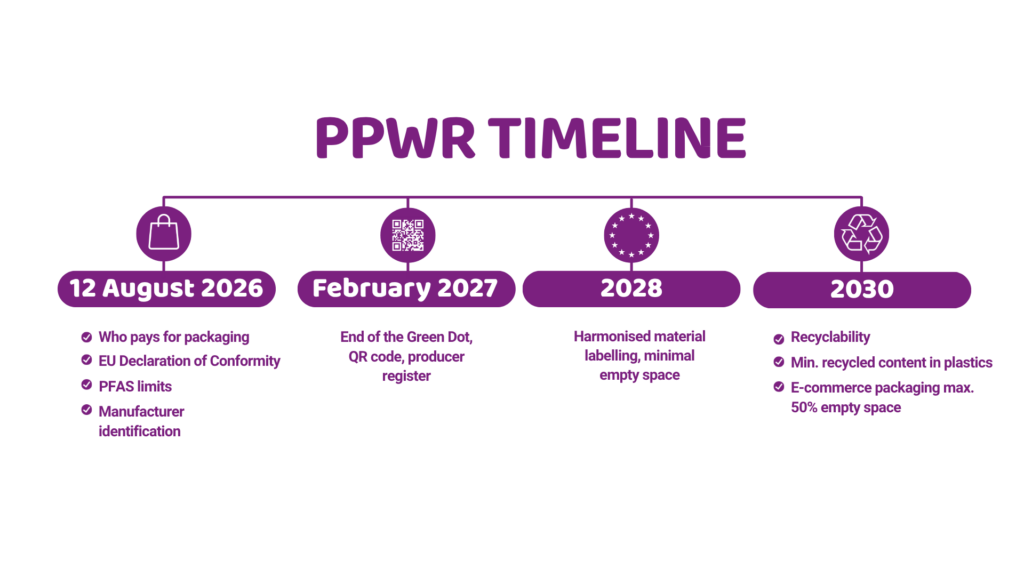
From that date, all packaging placed on the EU market must meet these rules:
- EU declaration of conformity – the manufacturer confirms that the packaging meets the regulation. This covers, for example, heavy-metal limits, packaging minimisation and recyclability. The manufacturer must also hold the technical documentation.
- PFAS – food-contact packaging must not exceed the limits for “forever chemicals” (PFAS).
- Manufacturer identification – the packaging must show its type or batch and the manufacturer’s name and address. This can be on the packaging, in a QR code or in an accompanying document.
- Environmental claims such as “eco-friendly” or “recyclable” must be substantiated.
However, this is only the beginning. First, the Green Dot mark ends in the Czech Republic in February 2027. Instead, the take-back system will use a QR code, and a register of packaging producers will be created. Then, from 2028, empty space in sales packaging must be cut to the minimum. Harmonised EU material labelling will also start. From 2030, all packaging must be recyclable, at least to grade C. In addition, plastic packaging must contain a minimum share of recycled content. E-commerce and transport packaging may have no more than 50% empty space. Selected single-use plastic packaging will also be banned, for example for fresh food under 1.5 kg. Finally, large-scale recycling and higher recycled content will follow between 2035 and 2040. Exact dates depend on EU implementing acts.
Companies therefore have time to adapt – but only if they start early.
Who falls under the PPWR
The scope of the regulation is much wider than most companies think. In fact, it affects almost the entire supply chain:
- Brand owners who have packaging or products made externally but sell them under their own name.
- Importers of packaged goods from outside the EU. They must make sure the packaging complies before it is placed on the market.
- E-shop operators and fulfilment centres, because the empty-space limit for shipping boxes applies to them from 2030.
- Users of transport and group packaging, such as companies using pallets, stretch film or strapping. From 2030, reusable packaging targets will apply to them.
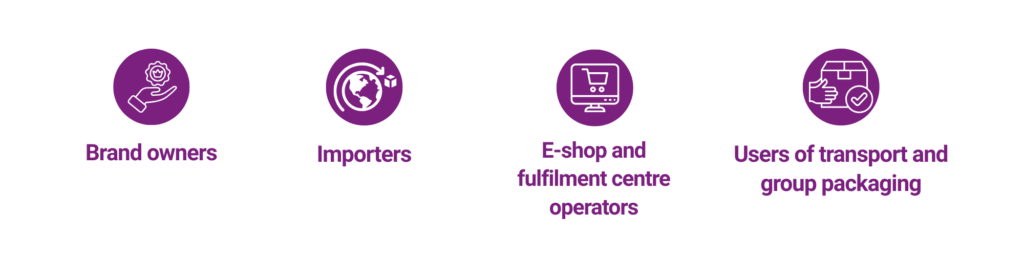
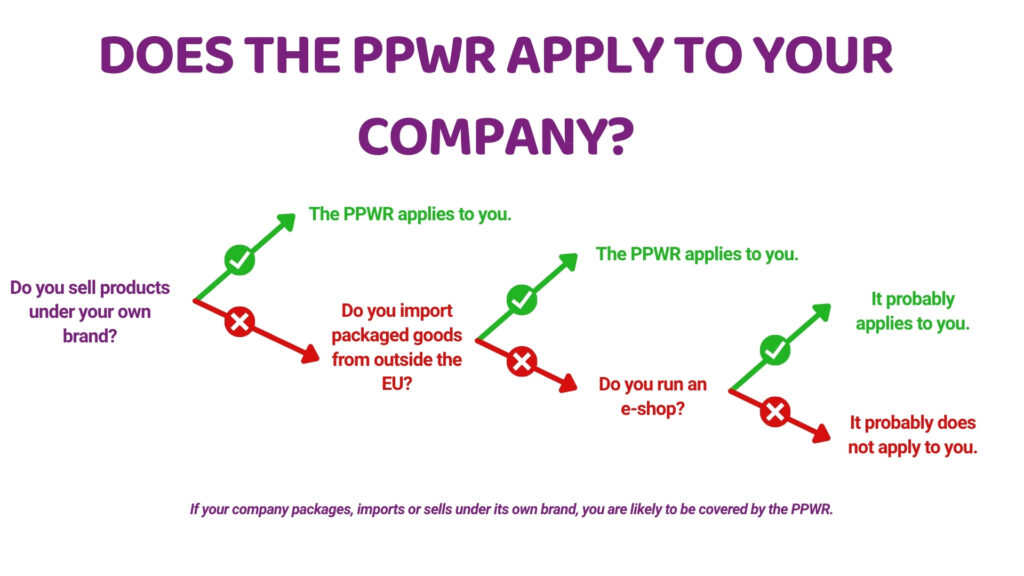
In other words, if your company packs, imports or distributes anything under its own name, the PPWR applies to you. This is true whether you make the packaging yourself or order it from a supplier.
What non-compliance can cost you
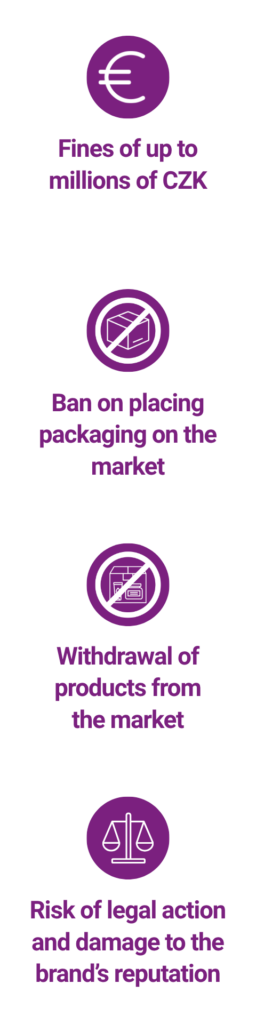
The regulation does not set uniform fines for the whole EU. Instead, each member state sets its own penalties. In the Czech Republic, the Packaging Act allows fines of up to millions of crowns.
Authorities can also ban the sale of non-compliant packaging or order its withdrawal from the market. Moreover, if you sell abroad, the rules and penalties of that country apply.
Why this can’t be left to the last minute
Suppose an audit shows that your packaging needs changes. For example, you may need a different material, smaller packaging or space for future harmonised labels. In that case, you face a redesign. This process has its own timeline. It is not linked to the legislation, but it decides whether you comply in time.
Developing a new design, approving the artwork, testing samples and production usually take 90 days. Roughly 30 days go to production and 60 days to transport if you source outside the EU. As a result, companies that wait until the last minute face heavy time and cost pressure. They also risk that non-compliant packaging cannot be sold by the deadline.
In other words, plan to start each redesign at least three months before the next PPWR deadline. This applies to material labelling in 2028 as well as to recyclability and empty-space limits in 2030.
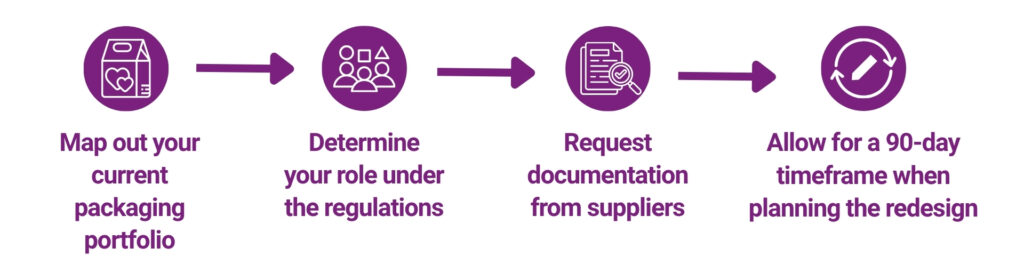
What to do now?
There is no need to panic or change all your packaging overnight. After all, EU legislation is phased in gradually and gives companies time to adapt. However, that time is running out, so the first steps should be taken now.
- Map your current packaging portfolio. Build a material map, from primary packaging to labels, adhesives, fillers and strapping. Then find out the exact material composition and real recyclability.
- Determine your role under the regulation. Are you a manufacturer, an importer or an e-shop operator? Your obligations depend on this role.
- Request documentation from your suppliers. This includes data sheets, certificates and proof of recycled content or absence of PFAS. Without these documents, you cannot issue the mandatory EU declaration of conformity.
- Allow 90 days when planning a redesign. If you know your packaging needs changes, start now. Don’t wait for the final implementing acts.
How SALE helps
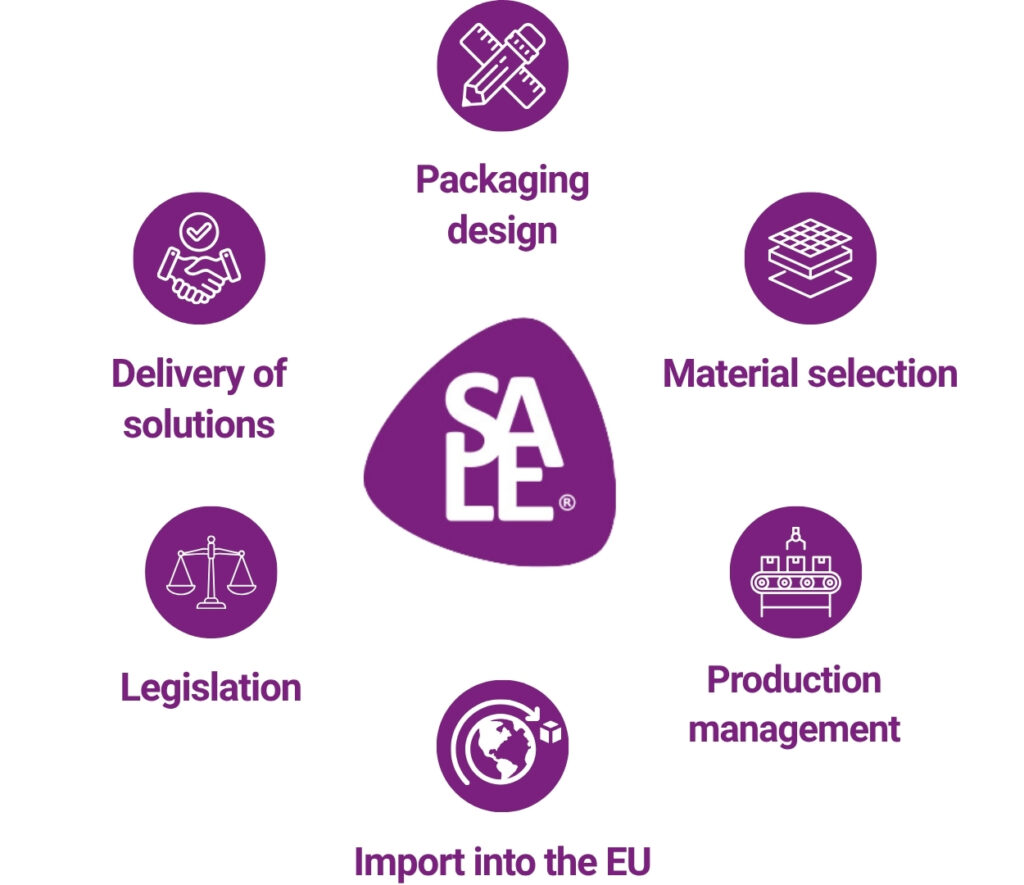
SALE manages the entire packaging production cycle. This covers design, material selection, production oversight, import into the EU and delivery. As a result, we follow legislative changes continuously. We also design packaging to meet future PPWR requirements, including recyclability and the necessary technical documentation.
SALE s.r.o. is a client of the EKO-KOM system (EK-F00040209) and meets its obligations under the PPWR. We also pay the fees for packaging we are responsible for. This includes imported cartons, neutral packaging and packaging for micro-enterprises.
On request, we also issue an EU declaration of conformity and a packaging fee statement for supplied packaging.
What we need from you: when ordering, please tell us whether you are a micro-enterprise. Please also tell us whether you use the packaging yourself as the end user. That way, we can charge the packaging fees correctly.
We will be happy to consult and audit your current solutions. Together, we will make the move to the new packaging rules smooth and timely – without unnecessary risks or fines.
PPWR FAQ
The main PPWR rules have applied since 12 August 2026. Since then, packaging must meet basic composition requirements, such as PFAS limits for food-contact packaging. You also need technical documentation. However, the new harmonised sorting labels are expected to become mandatory only from August 2028.
The “manufacturer” is responsible. Under the PPWR, this is the brand owner, not just the factory. So if packaging carries your name or trademark, you are responsible for recyclability, labelling and the declaration of conformity. You also pay EKO-KOM fees. However, for micro-enterprises, the Czech supplier pays the fees.
Not for ordinary packaging. Sorting pictograms must be printed directly on the packaging. A QR code can replace them only on very small packaging. On the other hand, QR codes will be mandatory on reusable packaging to show collection points.
Penalties are set by national law. In the Czech Republic, fines can reach millions of crowns. In addition, authorities can ban the sale of non-compliant packaging or order its withdrawal. Abroad, local rules apply.
EKO-KOM mainly covers reporting packaging volumes and paying take-back fees. The PPWR, by contrast, adds EU rules on design and data. For example, these cover recyclability grades, empty space, labelling and technical documentation.
Does the PPWR apply to you?
Not sure whether the PPWR applies to you? Or how to approach a redesign? Write to us. We’ll review your portfolio and suggest next steps.
Note: The 90-day timeframe does not come directly from EU legislation. Instead, it is a practical figure from the supply and production market that SALE has long worked with. This article summarises public information on the PPWR as of the publication date. For your company’s specific situation, we recommend an individual consultation.


